Introduction
“Is marriage the only way to define a relationship between two persons?” For a long time in India, the answer to this question seemed unquestionable. Marriage is considered as a sacred and pious institution in Indian society it has traditionally been viewed not just a personal bond but as a social and cultural institution which is deeply rooted in Indian society. However, in recent years, we can see this perception has begun to advance and the he word “Live-In” has come into existence, once it was considered to be a taboo and socially undesirable, are now gradually gaining reflectiveness and, acceptance to some extent. Today, discussions around live-in relationships are also becoming relevant in academic environments, including law education and LLB college classrooms, where students examine evolving legal and social perspectives. Once considered taboo and socially undesirable, live-in relationships are now gradually gaining recognition and acceptance to some extent.
This shift is largely due to changing lifestyles, increased urbanization, higher levels of education, and increasing exposure to worldwide cultures. Young individuals today are more tilted towards prioritize compatibility, personal choice, and independence over traditional expectations. As a result, live-in relationships are no longer hidden realities but are becoming part of mainstream discussions. Alongside these social changes, the Indian legal system has also been compelled to address and interpret the status and rights associated with such relationships.
Understanding Live-in Relationships
When two individual prefers to live together without entering into legal marriage agreement is meant to be a live-in relationship. It is different from marriage, which is governed by personal laws and statutory provisions of an individual, live-in relationships do not have a specific legal definition in India.
These relationships are not considered to be illegal in spite of no legal recognition. Indian laws permit two consenting adults living together. A broader perspective is given to individual freedom and right to choose their partners without interference of anyone else. Over the period of time, courts have acknowledged that the nature and concept of marriage relationships is changing the society legal system must adapt with it accordingly.
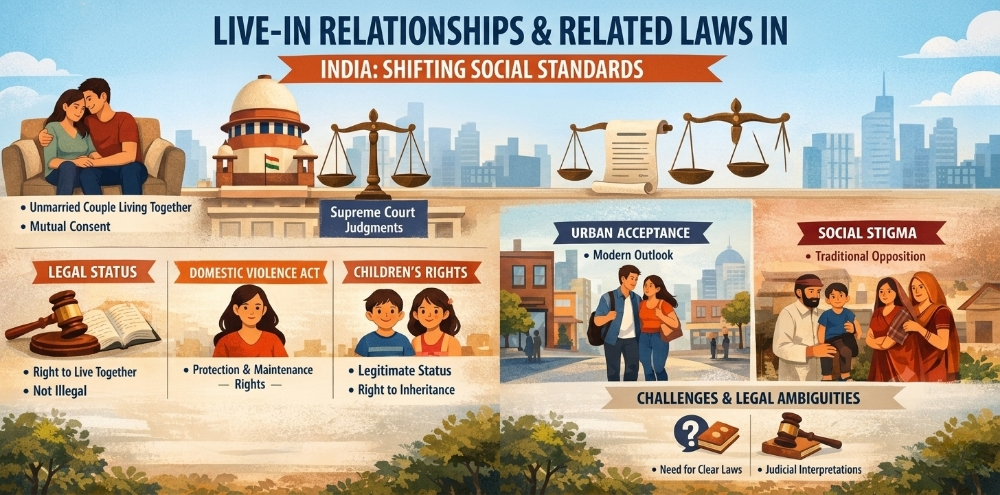
Changing Social Rules in India
The rapid rise of live-in relationships in society reflects a broader transformation in Indian society. Conventionally, relationships were intensely influenced by family hopes, community system, and values. Marriage was considered to be very important, and any deviance from this was often not accepted by the society.
New India presents a different picture now, more and more population is moving to capitals for education and employment, people are becoming more financially independent and socially aware. Exposure to global media and ideas is also considered to be a major shift in outlook towards relationship. For many young people, Many young minds finds that live-in relationships provide an opportunity for two individual to understand each other and take decisions wisely.
Simultaneously we can derive, that the acceptance of such relationships is not uniformly followed in the country .In urban places there is much more openness, as compared to smaller cities and rural areas which often hold conservative opinions.
Constitutional Provision: Right to Life and Personal Liberty
Our Apex court has consistently held that the right to life includes the right to live with dignity and freedom of personal choices, including the choice of a companion. Various important interpretations have led to indirect legitimacy to live-in relationships. By consenting adults have the right to live together without intervention, the courts have strengthened the idea that personal relationships fall within the sphere of individual liberty.
Judicial Recognition and Landmark Judgments
There is absence of legal framework regarding live in relationship, but the judiciary has played a vital role in determining the legal structure of this right
In D. Velusamy v. D. Patchaiammal, the Supreme Court in this laid down important recommendations to decide whether a live-in relationship is likely to be considered as same as marriage.” So, According to the Court, in such a relationship parties must be legally eligible to marry and they must have cohabited together for a significant period, and must present themselves to society as a married couple. This distinction is important because only relationships meeting these criteria are entitled to certain legal protections.
In Indra Sarma v. V.K.V. Sarma, case the Supreme Court determines that not all people who have consented to live together without lawful marriage are covered under legal recognition . However, the court also stated that a woman in genuine relationships should not be left out without any protection. The Court emphasized the urgency of protecting violence and graves the need for preventing exploitation and ensures fairness and justice, to the vulnerable partners.
Partners Legal Rights in Live-in Relationships
Live-in relationships in India do not enjoy the same legal status as marriage; Indian law provides certain provisions and protections to individuals those who are involved in such engagements.
Protection of Women from Domestic Violence Act, 2005, this act gives protection against physical, emotional, or economic abuse under such relationship. This law expands s the scope of marriages and allows long term living relationship in category of legal marriages up to some extent.
The Supreme Court address another significant right which recognize such children born out of such relations as legitimate, and granting them right inherit property from their parents. These steps reflect a progressive approach aimed at children rights and dignity.
Challenges Faced by Couples
Despite legal recognition, individuals in live-in relationships often face several challenges in their daily lives. Social stigma remains one of the biggest obstacles.
Couples may encounter disapproval from family members, criticism from society, and difficulties in finding acceptance within their communities.
Housing discrimination is another common issue. Many landlords are reluctant to rent their apartment to unmarried couples, while citing moral or social concerns. This type of social exclusion creates difficulties for the partners living without lawful marriage
This creates practical difficulties for individuals who choose to live together.
Furthermore, the lack of awareness about legal rights often leaves individuals vulnerable. Many people are unaware that certain protections are available to them, particularly under laws related to domestic violence and maintenance.
Legal Gaps and Unsettled Issues
Indian judiciary has played a vital role in protecting legal rights of individual’s .Still several legislative gaps remains. There is lack of comprehensive legislation which clearly states the rights and duties of companions living in relationships together. This lack of transparency and legal framework can lead to misunderstanding and inconsistent outcomes in legal disputes which varies from case to case.
Property rights between partners are not well established, which can create complications in cases of separation. Additionally, proving the existence and nature of a live-in relationship in court can be difficult, especially in the absence of formal documentation.
All these challenges denote that there is need of well-structured legal framework that addresses this key issue and related complexities of such relationships while ensuring fairness and justice.
Conclusion
We can see the significant shift in Indian society how relationships perceived and practiced. Conventional norms are now challenged to give individual autonomy for choosing their partners. Varity of rights have been covered under Article 21 by Indian Judiciary and has expanded its scope by providing important guidelines and progressive steps to recognize and protect such relationships, and many legislative gaps remains in this regard, and there is a need for more legal clarity and social acceptance.
Today India is standing at a point where tradition meets modernity. The rapid acceptance of live-in relationships reflects a broader transformation of societal values. There should be a balance between Individual dignity and social harmony, where society is adopting with new changes. Ultimately, the evolution of live-in relationships is a shift from legal marriages in India is not just about legal recognition; it’s about refining and redefining the concept of relationships in a rapidly changing world.
Frequently Asked Questions (FAQs)
Q.1. What is a live-in relationship about?
Ans. When two persons choose to company each other and decide to live like couple without any legal obligation and share companionship with their consent.
Q.2. Is live-in relationships legalize in India?
Yes, it is not a crime when two persons live together without marriage. It is completely legal.
3. Is there any provision regarding maintenance in live-in relationship?
Yes, in some cases claim is maintainable. Courts will rely on certain facts that the relationship is long-term and it resembles like a marriage, courts may grant protection for the wellbeing of the women.
4. What are the challenges that faced by couples in live-in relationships?
Couples often face social stigma, housing discrimination, lack of legal clarity, and limited awareness about their rights.
Author
Dr. Vijay Kanwar
Assistant Professor, Department Of Law
Biyani Group Of Colleges, Jaipur