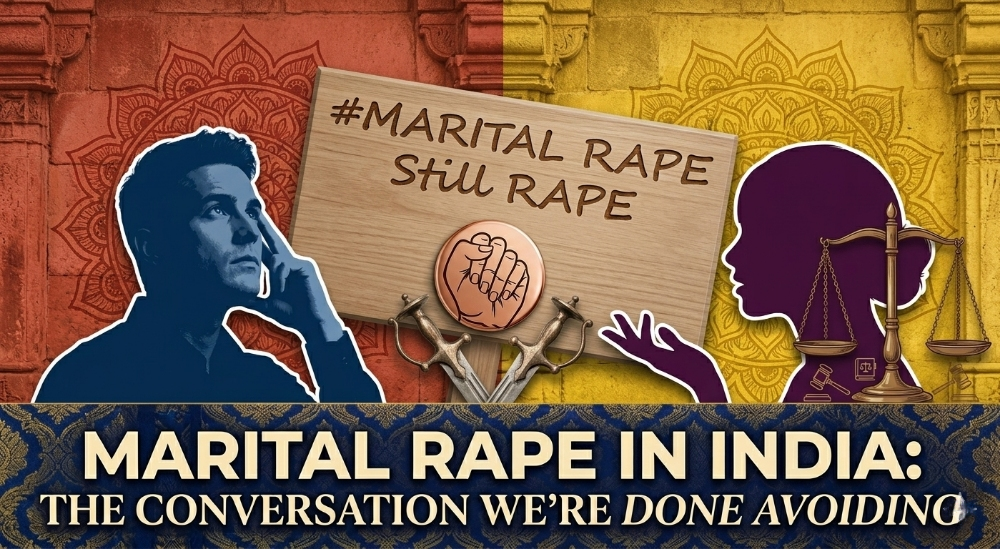
There are some issues we would rather just not talk about. We whisper about them, we leave the issue or we pretend they do not exist at all. Marital rape is at the top of that list. It fall in this messy, silent space between law, culture, society and the four walls of a home.
Most people agree that rape is a heinous crime. But the second you mention “marriage,” the room goes quiet. People start talking about “private matters” or “family honor.” But let’s get real: is it actually a private matter when someone’s basic dignity is being crushed?
For way too long, the narrative in India has been that marriage is a blanket consent form. It was just… accepted. A lot of people still think that once a woman gets married, sex becomes a “duty” she owes. This is not just a backward mindset, it is actually written into our laws. Right now, definition of rape has a massive loophole that protects husbands. This single exception leaves millions of women with zero legal protection against the person they are supposed to trust most under BNS, 2023.
We need to leave that silence around the truth. Marital rape is not about sex—it is about power and a total lack of consent. Consent is not something you sign away on your wedding night. It is a “yes” that has to happen every single time. A marriage certificate is not a deed of ownership over another person’s body.
What the Courts Have Said (And What They Haven’t)
It is frustrating because our courts talk a big game about “dignity” and “privacy,” yet the law itself is stuck in the past. Back in 1984, in the Harvinder Kaur case, the Delhi High Court basically said that the Constitution should not enter the home because it might “disturb” the marriage. That was more than forty years ago. Society has moved on and now Our thinking has to move with it. Since then, the Supreme Court has made some big moves. In cases like Madhukar Narayan Mardika case, the court recognized a woman’s right to privacy. Then, in the Puttaswamy judgment, they made it clear, privacy includes the right to make choices about your own body. This leaves people with a massive contradiction. If the law protects our “intimate choices,” how can it ignore forced sex just because the couple is married? We saw a hope in the 2017 Independent Thought case. The Court decided that sexual intercourse with a wife, who is under 18 year of age is rape. It was a huge win for children, but it left adult women in silence. It proved the Court can change the rules—it just has not finished the job yet.The Debate: Equality vs. “What If?”
The legal argument is pretty simple. Article 14 of our Constitution promises equality. But right now, we have two different rules. If a man forces himself on a woman he is not married to, it is rape. If he does it to his wife, it is not. Why? Just because of a marriage license? It makes no sense. Then there is Article 21 of constitution of India i.e. the right to life and dignity. Living in fear inside your own house is not “living with dignity.” It is mere surviving. Of course, critics always bring up the “misuse” card. They worry about false cases or families breaking up. Look, any law can be misused. We do not get rid of Section 498A or even basic theft laws because someone might lie. You do not deny protection to millions of victims just because you are afraid of a few bad character.The Bottom Line
Countries all over the world have already fixed this. The UN has been calling on India to change this law for years. The home should be a safe haven, not a place where violence is legal. The silence is finally breaking. It is slow but eventually it is working.FAQ’s-Understanding the Legal Landscape
1. Is marital rape currently an offence in India?
Section 375 of the Indian Penal Code (now section 63 Bharatiya Nyaya Sanhita) contains an exception no. 2 so, technically answer is no. It states that sexual acts by a man with his own wife, provided she is above 18 do not constitute rape.
2. Why the law has not been changed yet?
The government and society argue that criminalizing it might lead to the “dissolution of the institution of marriage” and could be misused. However, some activists argue that a marriage based on forced intimacy is already broken.
3. What did the Justice Verma Committee suggest?
After 2012 Nirbhaya case, committee strongly recommended that the exception for marital rape should be removed, stating that a relationship between the perpetrator and victim should not affect the ingredient of the crime.
4. Is there any relief to such woman under any law?
Although, she cannot take action for “rape” against her husband, but she can take protection under the Protection of Women from Domestic Violence Act, 2005, which recognizes sexual abuse as a form of domestic violence. She can also take action for cruelty under Section 498A now section 85 BNS.
5. Has any other country criminalized it?
Around 150 countries have criminalized marital rape, including the Australia, USA, Canada, and many other developing nations. The world is moving toward recognizing that “no means no,” regardless of marital status.
Author Mr. Amit Mothsra Assistant professor,Department of Law Biyani Group Of Colleges,Jaipur
Author Mr. Amit Mothsra Assistant professor,Department of Law Biyani Group Of Colleges,Jaipur